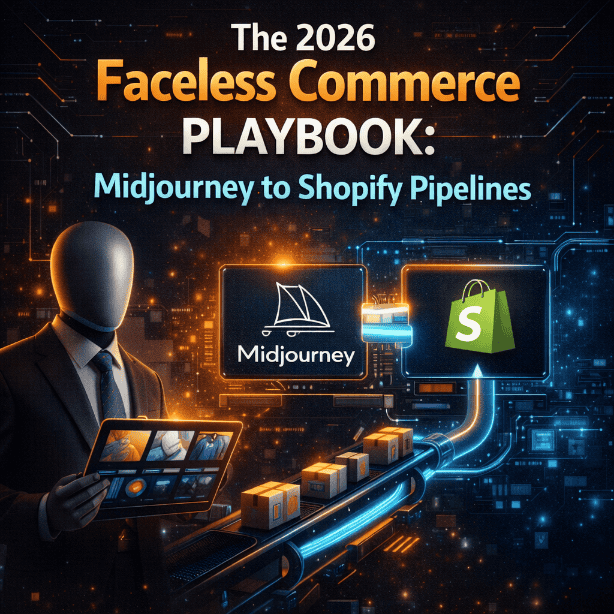

The era of begging micro-influencers for User-Generated Content (UGC) is officially dead. In 2026, relying on human actors to shoot iPhone videos for your dropshipping or private-label brand is an archaic, margin-destroying liability. Humans get sick, miss deadlines, demand royalty fees, and struggle to produce 4K cinematic lighting in their bedrooms. The new standard of e-commerce is entirely synthetic.
Welcome to the apex of Faceless Social Commerce. By weaponizing a combination of generative image models, temporal AI video engines, and headless serverless APIs, media operators are building multi-six-figure Shopify brands without ever touching physical inventory, buying a camera, or showing a human face.
We are no longer just making “funny AI videos” for YouTube AdSense. We are using generative AI to create hyper-realistic lifestyle product videos, piping them directly into TikTok and Meta ad managers, and aggressively arbitraging the cost of attention. This is the definitive 2026 engineering playbook for building a completely automated, high-margin faceless commerce brand.
Executive Summary: The Synthetic Pipeline
- Zero-UGC Architecture: Replacing expensive human actors with Midjourney and Kling 3.0 to generate impossible, high-end lifestyle shots (e.g., luxury watches on a snowy Alpine peak) for pennies.
- Headless Automation: Using Make.com to automatically sync AI-generated product videos directly to Shopify product pages, eliminating manual data entry.
- TikTok Ad Arbitrage: Leveraging hyper-fast, 3-second jump cuts with AI voiceovers to exploit TikTok’s top-of-funnel algorithm, achieving Cost Per Clicks (CPCs) 60% lower than traditional influencer ads.
Related Intelligence
Mastering faceless commerce requires a firm grasp on AI asset generation and pipeline hygiene. Review these core reports:
1. The Economics of Faceless Commerce vs. Traditional E-Com
To understand why enterprise operators are abandoning traditional marketing, you must look at the Cost of Goods Sold (COGS) matrix. In traditional e-commerce, the product is cheap to manufacture (e.g., $4 in China), but the Customer Acquisition Cost (CAC) is crippling. You pay an influencer $500 for a video, spend $1,000 on TikTok ads to test it, and pray the video converts before the algorithm burns it out (usually within 7 days).
When the video burns out, you have to pay the influencer another $500. This cycle destroys liquidity.
In Faceless Social Commerce, your creative iteration cost drops effectively to zero. If an ad creative burns out on a Tuesday, you simply prompt an AI engine to generate twenty new variations of the product in different cinematic environments by Wednesday morning. You are spending compute tokens, not influencer day-rates.
| Marketing Component | Traditional UGC (Human) Cost | Faceless AI Pipeline Cost | Turnaround Time |
|---|---|---|---|
| 5 High-End Lifestyle Photos | $350.00 (Photographer + Props) | $0.15 (Midjourney GPU tokens) | 10 Minutes vs. 14 Days |
| 3x 15-Second Video Ads | $800.00 (Micro-Influencer rates) | $4.50 (Kling 3.0 API generation) | 45 Minutes vs. 21 Days |
| Professional Voiceover | $150.00 (Fiverr/Upwork) | $0.30 (ElevenLabs API) | 2 Minutes vs. 3 Days |
| Total Campaign Launch | $1,300.00 Minimum | $4.95 Maximum | Instant Iteration |
2. Phase 1: The Visual Engine (Image-to-Video Pipelines)
To sell a product without showing a real human holding it, the product must look so visually arresting that the viewer stops scrolling on TikTok purely out of aesthetic shock. You cannot achieve this by typing a text prompt directly into a video generator. Text-to-Video models still hallucinate product labels and logos.
The enterprise pipeline is strictly Image-to-Video.
Step A: The Base Asset Generation
First, we use Midjourney to generate the hyper-realistic, static product image. Let’s assume we are selling a minimalist men’s tactical watch. Midjourney allows us to enforce strict compositional rules.
/imagine prompt: A hyper-realistic, macro product photography shot of a matte black tactical men's watch resting on a wet, mossy rock. Cinematic volumetric lighting piercing through dense jungle canopy. Water droplets on the watch face. Shot on 85mm lens, f/1.8, 8k resolution, photorealistic. --ar 9:16 --style rawMidjourney will generate a flawless, static vertical image of this watch. Because we are selling a private-label product, we can use Photoshop’s Generative Fill (or simply an AI logo-swap tool) to seamlessly map our brand’s transparent PNG logo onto the watch face perfectly.
Step B: The Temporal Motion Matrix
A static image will not convert on TikTok. We must animate it. We take our perfect, branded Midjourney image and feed it into a temporal video engine. While Google Veo 4 is great for YouTube B-roll, Kling 3.0 is the undisputed king of Image-to-Video product animation in 2026.
We upload the image to Kling and use a specific “motion brush” prompt:
Motion Prompt: The watch remains perfectly stationary. Gentle cinematic mist rolls in from the background. A single water droplet falls from the jungle canopy, splashing onto the glass face of the watch in slow motion. Subtle camera pan right.Kling 3.0 anchors the product (preventing the logo or watch shape from morphing) while animating the surrounding physics. You now have a 5-second, 4K lifestyle shot that looks like it was filmed by a $10,000 RED camera crew. The total cost to produce this asset was roughly $0.15.

3. Phase 2: Building the Faceless Sales Funnel
Generating the video is only the top of the funnel. Now we have to convert that attention into a transaction. To do this without human intervention, we construct a fully automated, headless infrastructure.
The Sonic Hook
Faceless videos require aggressive audio to keep viewers hooked. We use ElevenLabs to generate a hyper-realistic voiceover. In 2026, we avoid the “standard TikTok robot voice.” We use their Professional Voice Cloning feature to map the script onto a gritty, cinematic voice actor. This adds massive perceived brand value to a dropshipped product.
The 3-Second Rule
In CapCut or Premiere, we never let a single visual stay on screen for more than 3 seconds. We cut from the macro watch shot, to an AI-generated shot of a man wearing a suit, back to the watch. This hyper-pacing forces the TikTok algorithm to register high engagement.
The Serverless Shopify Sync
If you are testing 10 products a week, manually uploading AI images and writing descriptions for your store is a bottleneck. Enterprise operators use Make.com to bridge the gap between their AI generation and their storefront.
- 1 The Trigger: An AI image is dropped into a specific Google Drive folder.
- 2 The Brain: Make.com triggers Claude 3.5 Opus to scan the image and write an SEO-optimized product title, a high-converting bulleted description, and suggest a retail price.
- 3 The Execution: Make.com sends an API call directly to your Shopify account, creating a live product page, uploading the AI image as the primary photo, and publishing the listing automatically.
4. Phase 3: TikTok Ad Arbitrage and Scaling
Arbitrage, in marketing terms, is buying attention for a penny and selling it for a dollar. With traditional UGC, this gap is razor-thin. With Faceless Commerce, the gap is massive because your creative iteration is infinite.
The TikTok Ads algorithm favors accounts that upload fresh, high-quality creative constantly. When an ad runs for a few days, “ad blindness” sets in. The Cost Per Click (CPC) skyrockets from $0.30 to $1.20, killing your profit margins.
Because you are not waiting on a human influencer to mail you a new video, you can execute Creative Flooding. You feed your base product image into Kling 3.0 and ask for twenty different environments (the watch in the snow, the watch in a neon cyberpunk city, the watch underwater). You launch 20 different ad sets simultaneously at $20/day.
You kill any ad set with a CPC over $0.50 after 24 hours. The AI variants that resonate with the algorithm will secure a hyper-low CPC (often around $0.15). You scale the budget on the winning AI creatives vertically. Because the video looks cinematic and the ElevenLabs voiceover sounds premium, the consumer inherently trusts the Shopify landing page, resulting in massive conversion rates for products you don’t even physically stock yet.

5. Advanced Quality Control: Avoiding the AI Slop Trap
As the barrier to entry drops, millions of amateurs will flood TikTok with cheap, unedited AI video. To maintain a premium brand image and high product pricing, you must elevate your faceless content above the “AI Slop.”
Never run a raw, low-resolution generation as an ad. Always pass your B-roll through an enterprise upscaler. We highly recommend piping your final assets through TensorPix AI via API before uploading them to TikTok. TensorPix removes the weird compression artifacts and “flicker” that often plagues Image-to-Video generation, ensuring the product looks tangibly real on a mobile screen.
The Future is Synthetic
The operators who win in the 2026 e-commerce landscape will not be the ones with the best physical cameras or the most charismatic influencers. The winners will be the digital architects—the operators who can connect a Midjourney prompt to a Kling 3.0 animation, wrap it in an ElevenLabs voiceover, and automate it into a Shopify store using serverless logic.
By removing the human element from your creative pipeline, you eliminate the highest cost of your business. You stop trading time for money, and you start trading API tokens for equity.